Executive Summary
Enterprise Deployment Orchestration Platform is an enterprise deployment orchestration platform designed to replace fragmented pod-wise Jenkins and legacy handoff workflows. After a focused Q2 2026 delivery cycle, the platform achieved a Conditional Go for non-FedRAMP microservice production deployments, with VM-based workloads and FedRAMP scope deferred to subsequent phases.
Business Challenge
Prior to Enterprise Deployment Orchestration Platform, deployment workflows at Qualys were fragmented and operationally expensive:
- No standardized deployment workflow — Each pod and environment used Jenkins jobs or manual runbooks with inconsistent steps.
- Manual coordination — Configuration sync, dependency checks, and deployment handoffs required heavy SRE and EngOps coordination.
- Weak version binding — Application and configuration versions were not strongly coupled, increasing drift and rollback risk.
- No centralized dependency registry — Teams could not automatically validate whether upstream services were healthy before deploying.
- Limited multi-pod support — Bulk or coordinated releases across multiple pods were difficult to orchestrate.
- Poor deployment visibility — Leadership, SRE, and engineering lacked a single pane of glass for deployment status, history, and health.
- Inadequate auditability — Deployment traceability and compliance reporting were hard to reconstruct.
- These gaps increased lead times, error rates, and operational risk as the engineering portfolio scaled. A unified platform was needed to standardize deployments while preserving safety and auditability.
Program Context
Implement Continuous Delivery (CD) as the enterprise-standard deployment orchestration platform for standardized, scalable, observable, and dependency-aware deployments across engineering and production pods.
Responsibilities
- Own end-to-end program governance for Enterprise Deployment Orchestration Platform, including charter, roadmap, milestones, and delivery timeline.
- Coordinate cross-functional stakeholders across engineering, SRE, DSRE, security, and leadership, and drive issues to closure through the right owners.
- Manage risk, track production blockers, and ensure all go/no-go criteria are met before launch.
- Facilitate security and compliance approvals (ARB, SecOps, QUASAR, ProdSec) while preventing FedRAMP scope from blocking the non-FedRAMP rollout.
- Oversee operational readiness, runbooks, observability, rollback planning, and SRE sign-off.
- Produce decision artifacts such as the go/no-go checklist, leadership communications, and case study, and present clear recommendations with documented sign-off.
Execution
The program was delivered in three phases.
Phase 1 — Initiation & Development (Jan–Apr 2026)
- Program kickoff and stakeholder alignment
- MVP backlog freeze and Jira epic/story creation
- Pilot application selection
- Core feature development: UI/backend, Config Watcher, Quad Agent, dependency graph, RBAC, LDAP, scheduling, and analytics
Phase 2 — Engineering Rollout & Validation (May–June 2026)
- Dry-run environment setup on engineering pods
- Pilot app onboarding and deployment on selected pods
- Broader engineering pod rollout for microservices and VM-based services
- SRE and EngOps validation of upgrade scenarios, dependency management, rollback, and parallel deployment
- ARB, SecOps, QUASAR, GRC, SIEM, and Platform Security clearances obtained
Phase 3 — Production Readiness & Go/No-Go (Aug 2026)
- Platform deployed on Ops-Staging
- Microservice deployments validated on Ops-Staging
- Production infrastructure readiness planning initiated by DSRE
- Capacity planning reviewed: 80 concurrent deployments tested on a 16-CPU / 32-GB control node
- Final leadership Go/No-Go review held
Outcomes
- Pilot feedback positive
- Core platform operationally ready
- Microservice deployments validated
- Observability and resilience in place
- Operational runbooks available
Lessons Learned
- Separate compliance tracks early. FedRAMP/SCR approvals move on a different cadence than engineering delivery. Ring-fencing scope allowed non-FedRAMP value to ship without being blocked.
- VM and microservice deployments need distinct validation tracks. VM onboarding revealed unique blockers that would have delayed the entire program if bundled with microservices.
- Human review of AI-generated configs is non-negotiable. Leadership explicitly required the two-person SRE review process to be documented, signed, and audited.
- Capacity and DBRE readiness are first-class deliverables. Treating infrastructure readiness as a side activity creates last-minute risk; dedicated owners and tickets are essential.
- Pilots surface integration issues better than synthetic tests. Real application pilots uncovered practical concerns that lab tests did not.
- Operational runbooks and RACI are part of the product. A technically ready platform is not production-ready without documented support, escalation, and rollback procedures.
- Keep leadership decision records explicit. The decision matrix and sign-off table provided clarity and defensibility for the Conditional Go call.
Architecture
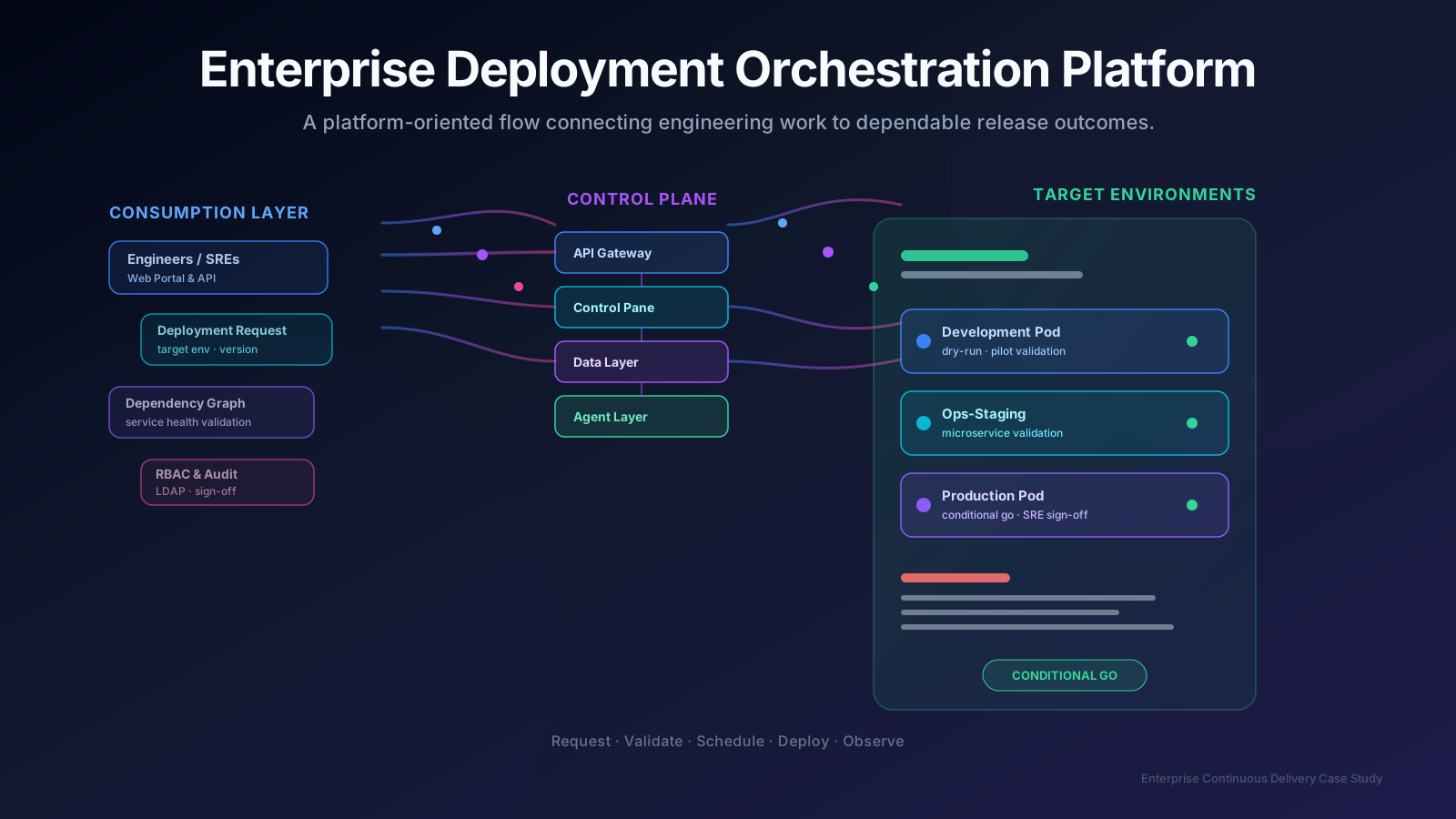
Continuous delivery capability model
A platform-oriented flow connecting engineering work to dependable release outcomes.
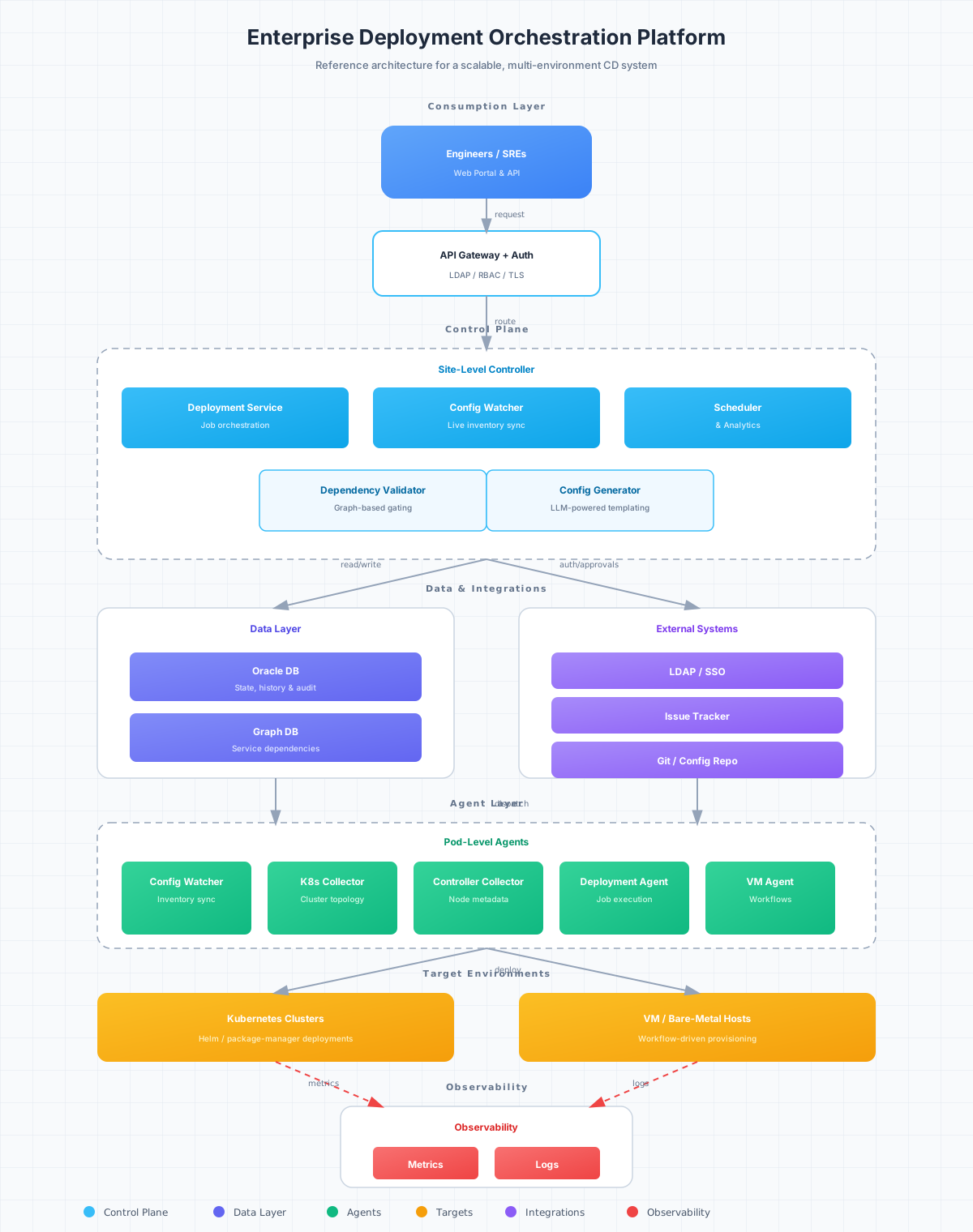
Layer 01
FrontEnd
Layer 02
Control Pane
Layer 03
Data Layer
Layer 04
Agent Layer
Layer 05
Target environment
Layer 06
Observability
Operating model
Stakeholder matrix
| Stakeholder | Engagement |
|---|---|
| DevOps Engineering team | Development of the platform |
| Application teams | Adoption, onboarding, real-world validation |
| SRE teams | Adoption, onboarding, real-world validation |
| EngOps teams | Adoption, onboarding, real-world validation |
| DSRE teams | Adoption for DevOps components, Production infrastructure, capacity, |
| Engineering leadership | Prioritization, governance, and risk visibility |
Risk discipline
Risks and responses
Risk
Inconsistent adoption across engineering teams
Response
Use shared practices, visible ownership, and iterative feedback loops