Executive Summary
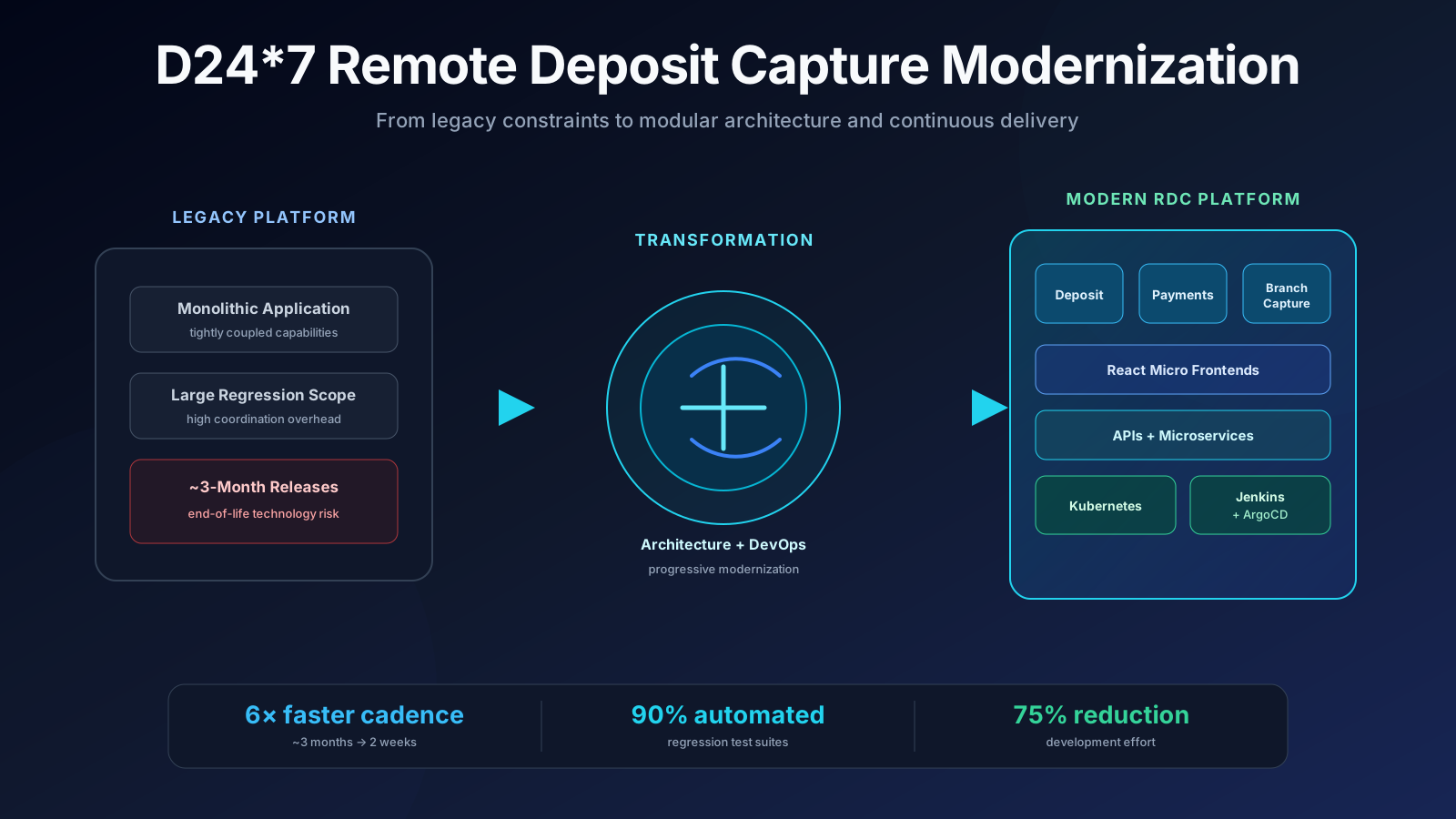
Deluxe's Deposit 24/7 (D247) supports Remote Deposit Capture for financial institutions and businesses. The modernization program replaced an end-of-life legacy foundation with a modular platform while maintaining service continuity and familiar customer workflows.
As Engineering Program Manager, I led delivery across a program of approximately 120 FTE, with direct ownership of Deposit, Branch Capture, and DevOps including ArgoCD. The program combined application modernization with delivery transformation, reducing the release cycle from approximately three months to two weeks.
Evidence
Program signals
- Release cadence
- 2 weeks
- Cadence improvement
- 6× faster
- Peak team size
- 120 FTE
- Major releases
- 6–8
- Development effort
- 75% reduction
- Regression automation
- 90% automated
Reduced from approximately three months.
Enabled by modular architecture, automation, and CI/CD.
Coordinated across engineering and supporting teams.
Delivered through the modernization program.
Development Efforts reduced significantly compared to legacy development
Automated Regression test suites.
Business Challenge
- Legacy risk: Core technology was approaching end-of-life and constrained future development.
- Limited documentation: Critical behavior and dependencies relied heavily on institutional knowledge.
- Slow delivery: Large releases required approximately three months of coordinated development, testing, and deployment.
- Tight coupling: Changes in one module increased regression scope and cross-team coordination.
- Customer continuity: Modernization had to preserve trusted workflows for existing users.
- Operational risk: A business-critical financial-services platform required controlled migration without service disruption.
Program Context
- Product scope: Deposit, Payments, and Branch Capture capabilities within the Remote Deposit Capture portfolio.
- Delivery scope: Application architecture, frontend, APIs, microservices, runtime, CI/CD, quality automation, and security controls.
- Direct ownership: Deposit, Branch Capture, and the DevOps / ArgoCD workstream.
- Program scale: Approximately 120 FTE at peak across engineering, quality, platform, security, product, and leadership stakeholders.
- Delivery objective: Move from large quarterly releases toward smaller, repeatable, independently deployable increments.
Responsibilities
- Program governance: Connected roadmap, scope, milestones, resources, dependencies, risks, quality, and release readiness.
- Release leadership: Planned and governed approximately 6–8 major releases from engineering readiness through production deployment.
- Workstream delivery: Led Deposit and Branch Capture modernization and coordinated their cross-platform dependencies.
- DevOps transformation: Owned the delivery model around Jenkins, Kubernetes, and ArgoCD.
- Resource planning: Managed capacity, skill alignment, legacy expertise, and workstream allocation across a large program.
- Risk management: Maintained critical-path visibility and escalated technology, dependency, quality, and production-readiness risks.
- Stakeholder alignment: Coordinated client leadership, product, engineering, quality, platform, security, and operations teams.
- Executive reporting: Communicated progress, decisions, trade-offs, risks, and outcome metrics.
Execution
Discovery and Transition
- Mapped legacy behavior, business rules, interfaces, and hidden dependencies before replacement.
- Engaged subject-matter experts to recover undocumented knowledge and support transition planning.
- Sequenced modernization to reduce end-of-life exposure while maintaining production stability.
Architecture Modernization
- Introduced React.js Micro Frontends to modernize experiences in manageable increments.
- Used APIs and microservices to separate business capabilities and reduce cross-module impact.
- Adopted Kubernetes as the runtime and orchestration foundation for containerized services.
- Preserved familiar user journeys where change did not create clear customer value.
Delivery Transformation
- Established Jenkins-based continuous integration and ArgoCD-based deployment automation.
- Integrated TOSCA regression automation, SonarQube quality analysis, and Checkmarx security scanning.
- Reduced release scope through modular delivery and stronger component isolation.
- Shifted delivery from approximately three-month release cycles to a two-week cadence.
Governance and Readiness
- Translated the roadmap into release-level scope, milestones, ownership, and acceptance criteria.
- Tracked planned versus delivered work, spillover, scope change, capacity, and dependency-driven variance.
- Governed engineering, QA, automation, environment, security, defect, business, and production readiness.
- Used risk and dependency reviews to manage downstream impact rather than report schedule variance alone.
Outcomes
- Faster releases: Reduced the release cycle from approximately three months to two weeks, a roughly 6× improvement in cadence.
- Modern architecture: Replaced tightly coupled legacy patterns with Micro Frontends, APIs, and microservices.
- More independent delivery: Improved component isolation reduced cross-module coordination and regression exposure.
- Automated deployment: Jenkins, Kubernetes, and ArgoCD created a more repeatable and visible path to production.
- Integrated controls: TOSCA, SonarQube, and Checkmarx embedded testing, quality, and security into delivery.
- Improved responsiveness: The modernized platform provided a stronger foundation for performance and scalability.
- Program delivery: Coordinated approximately 120 FTE and delivered 6–8 major releases across the modernization lifecycle.
Lessons Learned
- Legacy modernization is a knowledge challenge: Recovering undocumented behavior is as important as replacing technology.
- Architecture must improve delivery: Microservices and Micro Frontends create value when they enable smaller, safer releases.
- Modernization should protect customer familiarity: Technical change does not require unnecessary disruption to established workflows.
- DevOps is a platform capability: Architecture, automation, quality, security, and deployment must evolve together.
- Governance should focus on outcomes: Scope, capacity, dependencies, quality, and risk should connect directly to release readiness and business value.
- Incremental transformation reduces risk: Sequenced modernization supports learning while protecting production continuity.
Public References
- [UST — Deluxe modernized legacy application with DevOps and microservices](https://www.ust.com/en/insights/deluxe-modernized-legacy-application-with-devops-and-microservices)
Architecture
D247 modernized platform model
React.js Micro Frontends support Deposit, Payments, and Branch Capture experiences. APIs and microservices separate business capabilities, Kubernetes provides the runtime, and Jenkins with ArgoCD automates delivery through integrated quality and security gates.
Layer 01
Experience Layer
React.js Micro Frontends modernize individual experiences while preserving familiar workflows.Layer 02
API and Microservices Layer
APIs and microservices reduce coupling and isolate business capabilities.Layer 03
Kubernetes Runtime Layer
Kubernetes provides container orchestration and runtime scalability.Layer 04
CI/CD and Deployment Layer
Jenkins and ArgoCD provide an automated and repeatable deployment path.Layer 05
Quality and Security Layer
TOSCA, SonarQube, and Checkmarx provide testing, quality, and security controls.
Operating model
Stakeholder matrix
| Stakeholder | Engagement |
|---|---|
| Deluxe Product and Leadership | Aligned roadmap priorities, customer continuity, release scope, and business outcomes. |
| Engineering Teams | Coordinated Deposit, Payments, Branch Capture, frontend, API, microservices, and integration delivery. |
| DevOps and Platform Teams | Established the Jenkins, Kubernetes, and ArgoCD delivery model. |
| Quality and Security Teams | Governed regression automation, code quality, security scanning, and release readiness. |
| Program Leadership | Managed milestones, resources, dependencies, risks, releases, and executive reporting. |
Risk discipline
Risks and responses
Risk
Limited documentation and concentrated legacy knowledge
Response
Used structured discovery, SME engagement, knowledge recovery, and transition planning.
Risk
Legacy technology approaching end-of-life
Response
Prioritized the roadmap and modernized incrementally while protecting production stability.
Risk
User disruption from extensive interface changes
Response
Preserved familiar workflows and introduced modern experiences progressively.
Risk
Cross-module dependencies and regression exposure
Response
Applied modular architecture, dependency mapping, automated testing, and release governance.