Executive Summary
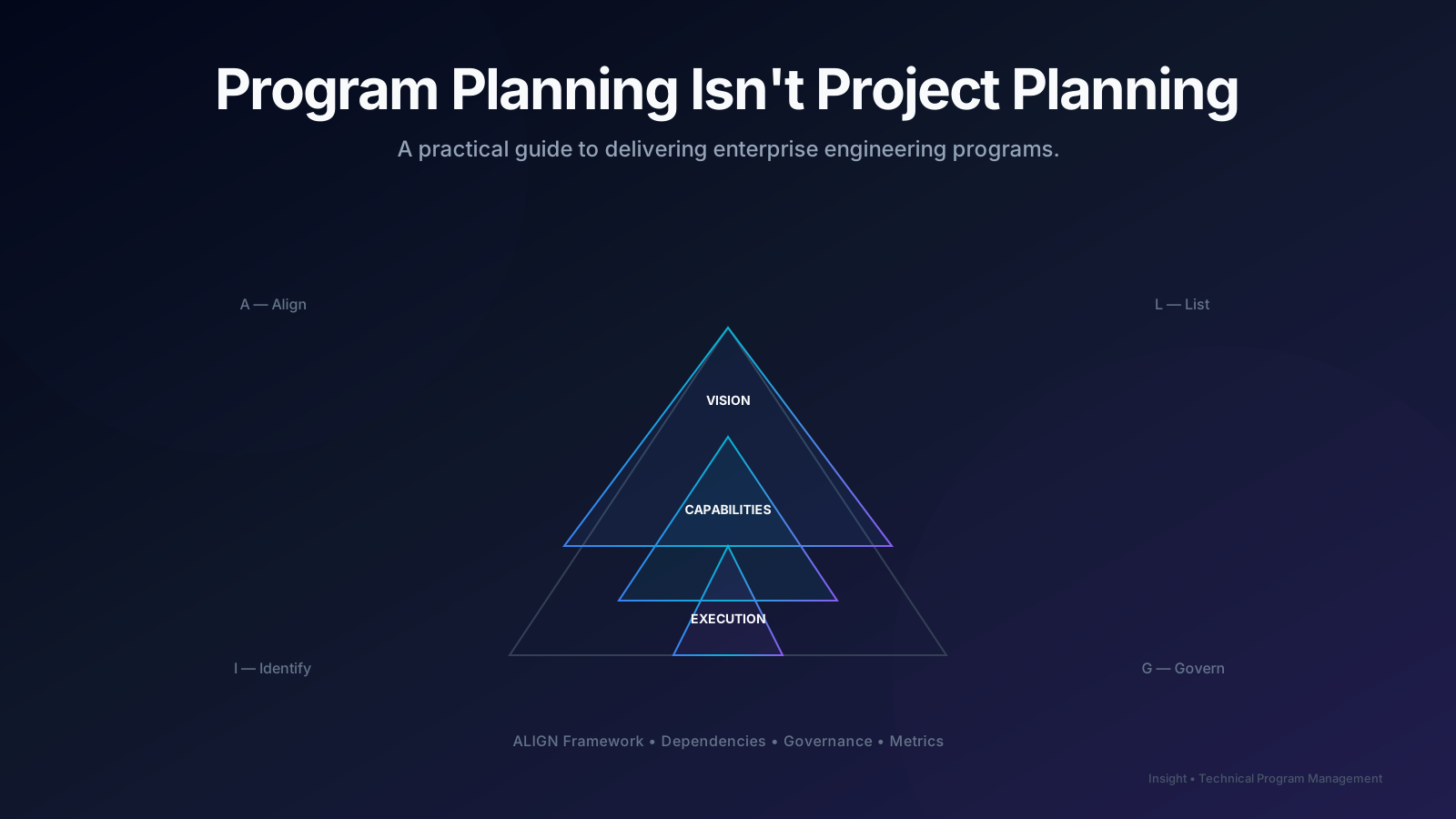
Program planning is not an extension of project planning.
Projects optimize for deliverables.
Programs optimize for business outcomes.
Most engineering organizations excel at the former and struggle with the latter because the skills, tools, and mental models required for each are fundamentally different.
This article introduces a practical planning framework called ALIGN to help Technical Program Managers define objectives, surface dependencies, and govern execution across multiple teams and workstreams.
It is written for senior TPMs, principal TPMs, engineering managers, platform leaders, and anyone accountable for delivering complex enterprise initiatives.
By the end, you will have a reusable approach for planning programs that connect engineering work to business results.
Why This Matters
Most engineering organizations are excellent at planning projects. Very few know how to plan programs.
I have seen this pattern across multiple enterprise transformations.
Teams produce reliable sprint backlogs, maintain clean Jira boards, and ship features on schedule.
Yet the broader initiative still misses its business goals.
The reason is usually the same: project planning tools and mindsets do not scale to program complexity.
Enterprise programs involve multiple engineering teams, platform groups, security reviews, compliance gates, vendor integrations, and executive stakeholders.
They span quarters or years and cut across organizational boundaries that no single team owns.
Each team may be executing well individually while the overall program drifts.
When this happens, the symptoms are predictable.
Milestones slip in silence.
Dependencies surface too late.
Scope expands without clear trade-offs.
Governance becomes a reporting ritual rather than a decision-making mechanism.
The cost is not just delay.
It is missed revenue, failed platform migrations, regulatory exposure, and eroded trust in engineering leadership.
A project can be late and still be considered successful if it delivers the promised feature.
A program that delivers every feature on time but fails to move the business metric is still a failure.
That distinction is why program planning deserves its own discipline.
Several failure modes repeat across organizations.
The first is the planning handoff. Strategy defines the vision, throws it to engineering, and expects execution to figure out the rest. By the time engineering surfaces trade-offs, political capital has already been spent on commitments that cannot be met.
The second is the illusion of alignment. Every team agrees on the goal in the kickoff meeting, but six weeks later each team is optimizing for a different definition of success.
The third is dependency optimism. Everyone assumes that other teams will be ready when needed because nobody wants to be the bearer of bad news early.
The fourth is metric myopia. Teams report velocity, burn-down, and feature completion while the business waits for adoption, revenue, and risk reduction that never materializes.
This matters because technical program managers are often the only role positioned to see the full picture.
We sit between strategy and execution, between engineering and business, between planning and delivery.
Our job is to make the program legible to executives, actionable to engineers, and accountable to outcomes.
Project vs Program
The confusion between projects and programs is not semantic.
It changes what you plan, how you measure success, and who owns the outcome.
A project is a bounded effort to deliver a specific output.
A program is a coordinated set of initiatives designed to deliver a strategic business outcome.
Projects ask: Did we ship it?
Programs ask: Did it change the business?
"Projects deliver software. Programs deliver organizational change."
A program charter should never begin with a feature list.
It should begin with the business change the organization needs.
Features are inputs.
Outcomes are outputs.
If your program plan reads like a long list of things to build, you are still planning projects.
Here is how the two disciplines compare side by side.
| Dimension | Project | Program |
|---|---|---|
| Scope | Defined deliverable or feature | Strategic outcome spanning multiple domains |
| Ownership | Project manager or engineering lead | Technical Program Manager or executive sponsor |
| Metrics | Output: shipped, tested, deployed | Outcome: adoption, revenue, risk reduction, operational savings |
| Timeline | Weeks to months | Quarters to years |
| Success | On time, on budget, in scope | Business value realized and sustained |
| Examples | Migrate a service to Kubernetes | Modernize the entire payment platform |
| Accountability | Team lead | Executive sponsor with cross-functional authority |
| Change model | Scope control through change requests | Adaptive prioritization based on outcomes |
Program Planning Pyramid
Effective program planning starts at the top and executes at the bottom.
I visualize this as a pyramid because each layer must support the one above it.
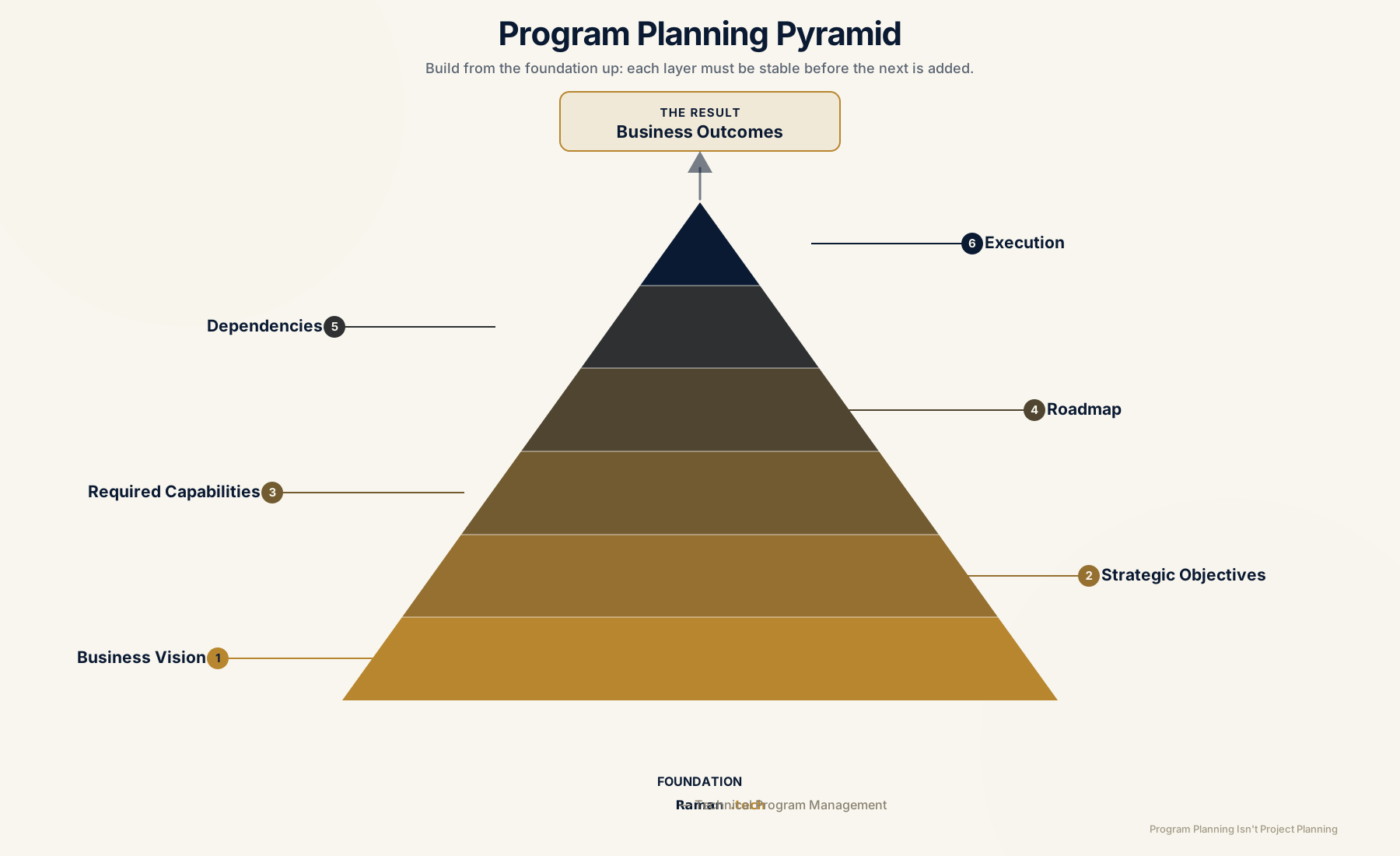
Each layer must be stable before the next layer is built.
The vision defines why the program exists and what strategic problem it solves.
Without a clear vision, every decision becomes subjective.
Objectives translate that vision into measurable goals that can be tracked over time.
Capabilities describe what the organization must be able to do once the program is complete.
They describe behavior and competence, not systems and features.
The roadmap sequences the work in phases that balance risk, value, and feasibility.
Dependencies expose what must be true before execution can succeed.
Execution is where the work happens.
Outcomes close the loop and validate the investment against the original business case.
"Skipping a layer is the most expensive shortcut in program planning."
Skipping a layer is the most common planning mistake.
Teams often jump from vision to execution and wonder why the result does not match intent.
A roadmap without capabilities is just a wish list.
Execution without dependency planning is just optimistic scheduling.
Planning Lifecycle
Program planning is not a single event.
It is a lifecycle that repeats and evolves as the program matures.
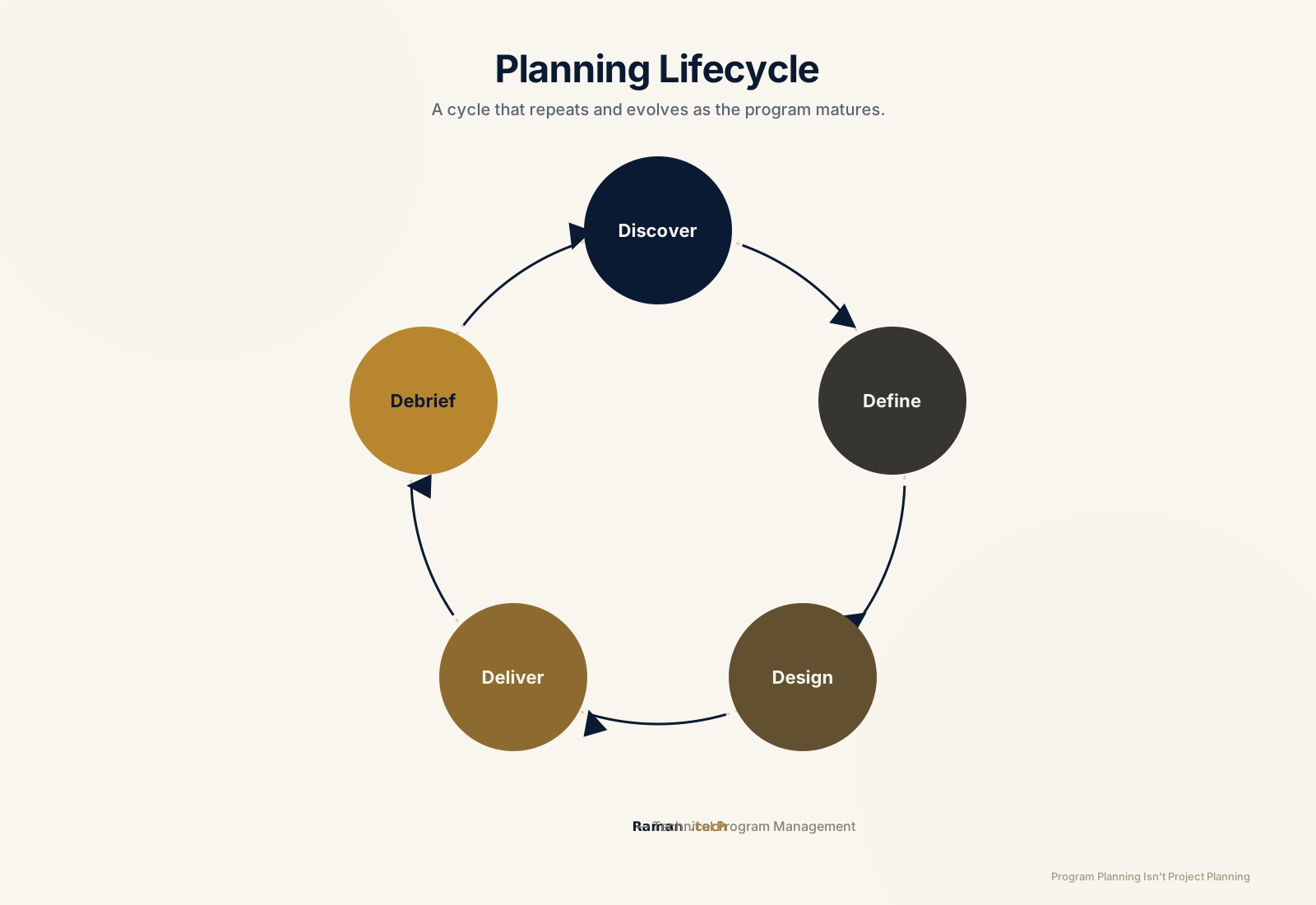
Discover is where you understand the problem, stakeholders, constraints, and strategic context.
This is the phase most teams skip because they believe they already understand the problem.
They usually do not.
Define is where you write the charter, align on outcomes, and establish the governance model.
Design is where you map capabilities, identify dependencies, build the roadmap, and define success metrics.
Deliver is where you execute, track, adjust, and communicate.
Debrief is where you measure outcomes, capture lessons, and transition to steady-state operations.
The debrief feeds back into the next cycle.
Most organizations are strong at Deliver and weak at Discover and Debrief.
That imbalance is why the same mistakes repeat.
The ALIGN Framework
I use a five-part framework called ALIGN to structure program planning.
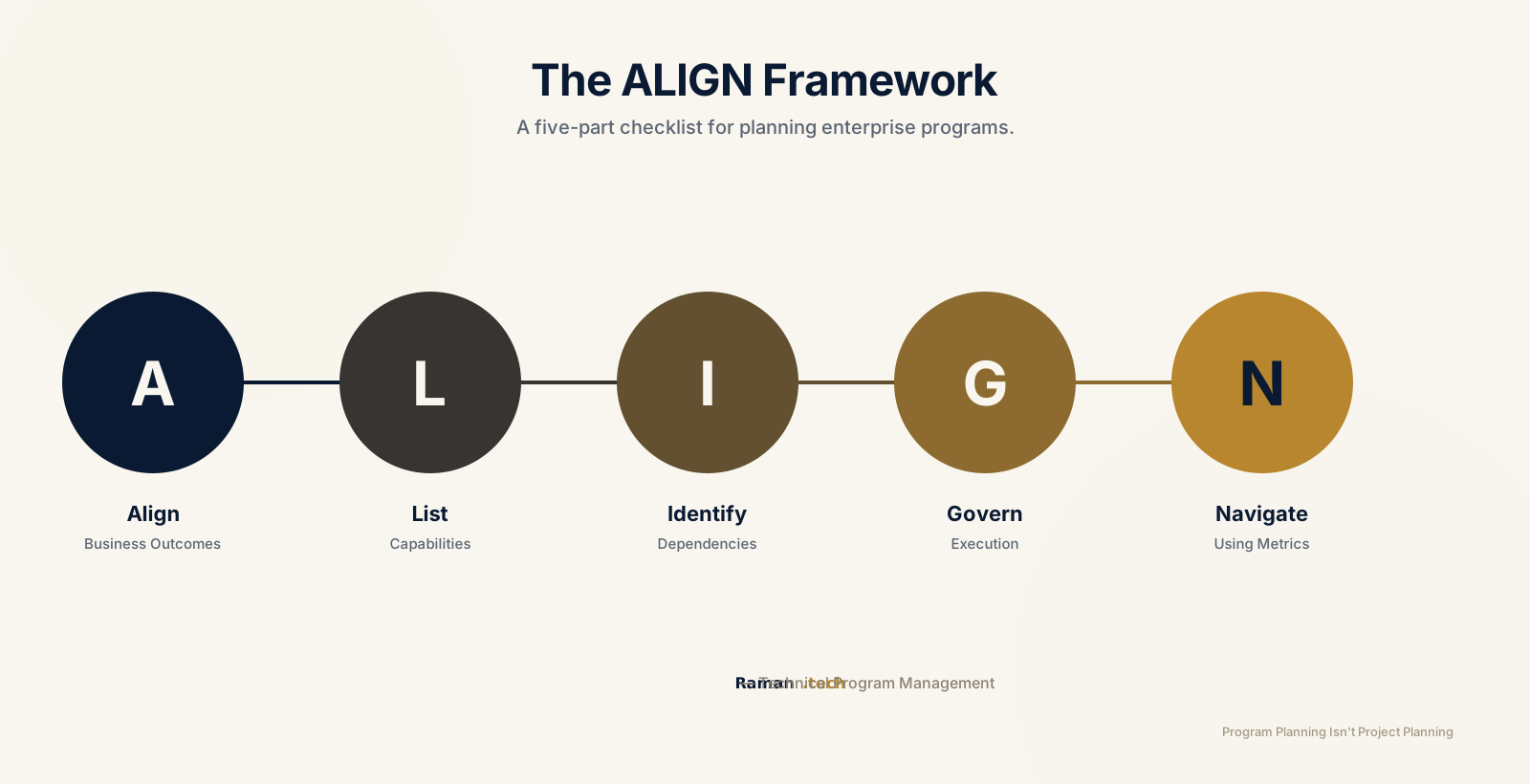
It is not a methodology.
It is a checklist for thinking.
Use it at the start of planning, during steering reviews, and when the program drifts.
I have used it for platform modernizations, compliance transformations, and enterprise DevOps programs.
In every case, the value came from forcing the right conversations before execution began.
A: Align Business Outcomes
Every successful program begins with a business outcome—not with a feature backlog.
One of the most common planning mistakes I see is teams jumping directly into Jira, creating Epics, estimating stories, and debating technical implementation before agreeing on why the program exists.
That approach may work for a project.
It rarely works for an enterprise program.
Large engineering programs involve multiple organizations, competing priorities, and significant investment. Unless every stakeholder shares the same definition of success, individual teams naturally optimize for their own objectives.
Platform Engineering may focus on standardization.
Security may prioritize compliance and risk reduction.
SRE may optimize operational stability.
Application teams often care about developer productivity and release velocity.
Leadership, however, expects measurable business outcomes.
One of my recent programs was the rollout of Enterprise Continuous Deployment (ECD)—an internal deployment platform designed to standardize software deployments across engineering organizations.
At first, many discussions naturally revolved around engineering deliverables.
Should we support another deployment strategy?
How should the deployment workflow evolve?
Which Kubernetes features should be included?
Those were important engineering discussions, but they were not the reason the program existed.
The real objective was much broader.
The organization wanted a deployment platform that could be adopted consistently across engineering teams while improving deployment governance, reducing operational overhead, standardizing deployment practices, and providing leadership with predictable production release management.
Deployment automation was only one capability supporting that outcome.
Similarly, the MasterHelm initiative was often viewed as a Helm chart standardization effort.
In reality, the business objective was much larger.
Engineering teams were maintaining deployment templates independently, introducing inconsistencies across applications and environments.
MasterHelm established a common deployment framework that reduced maintenance effort, improved deployment consistency, simplified onboarding for new services, and enabled future platform capabilities to be delivered once instead of being reimplemented by every engineering team.
The outcome was organizational standardization—not simply another Helm chart.
I have found that outcome discussions become significantly more productive when stakeholders stop talking about features and instead answer three simple questions:
- What business problem are we solving?
- How will engineering operate differently after this program?
- How will leadership know the investment was successful?
Those conversations expose assumptions surprisingly quickly.
During planning for the ECD rollout, Security emphasized deployment governance and approval workflows.
Platform Engineering focused on reusable deployment capabilities.
SRE wanted deployment reliability and operational visibility.
Engineering organizations expected a simpler deployment experience.
All of those perspectives were valid.
The responsibility of the Technical Program Manager was not to choose one over another.
It was to translate them into a shared outcome that every organization could support.
That alignment became the foundation for roadmap planning, dependency management, governance, and executive reporting throughout the program.
One lesson has remained consistent across every enterprise modernization initiative I have led.
Whether the program involved deployment modernization, centralized configuration management (CM), Vault AppRole adoption, or OpenTelemetry (OTel) rollout, engineering discussions always became easier once the organization aligned on the business outcome first.
Technical decisions changed throughout execution.
The business objective did not.
"Teams build features. Programs deliver business outcomes."
Before planning begins, I always ensure three questions can be answered clearly.
- What business outcome will change because of this program?
- How will we measure that change?
- Who is ultimately accountable for delivering it?
If those answers are unclear, the program is not ready for planning.
It is only ready for more discussion.
L: List Capabilities
Once business outcomes are aligned, the next step is identifying the capabilities the organization must build to achieve those outcomes.
This is where many program plans begin to drift.
Teams naturally think in terms of features because features are easy to estimate, assign, and track in Jira. Leadership, however, is investing in capabilities that transform how the organization operates.
That distinction is critical.
A feature delivers functionality.
A capability changes organizational behavior.
"Features deliver software. Capabilities change how the business operates."
One exercise I frequently use during planning is to ask engineering teams to temporarily ignore Jira Epics and instead answer a simple question:
"What should the organization be able to do after this program is complete that it cannot do today?"
The answers are almost always capabilities—not features.
For example, during the Enterprise Continuous Deployment (ECD) program, the objective was never to build deployment APIs, deployment dashboards, or release workflows.
Those were implementation details.
The capabilities we wanted the organization to achieve were much broader.
- Standardize application deployments across engineering organizations.
- Reduce manual deployment activities.
- Enable repeatable production deployments with consistent governance.
- Provide deployment visibility for Engineering, SRE, and Leadership.
- Support controlled rollout of platform capabilities across environments.
Those capabilities drove every roadmap discussion.
Only after they were agreed upon did engineering teams begin defining the individual features required to enable them.
The same approach proved valuable during the MasterHelm initiative.
Many engineers initially viewed MasterHelm as a shared Helm chart repository.
From a program perspective, that wasn't the capability we were building.
The capability was standardized Kubernetes application deployment across hundreds of services without requiring every engineering team to maintain its own deployment templates.
To achieve that capability, multiple engineering workstreams had to come together.
Features included:
- Shared MasterHelm framework
- Reusable deployment templates
- Centralized configuration management (CM)
- Standard deployment parameters
- Common deployment validation
- Environment-specific configuration management
Individually, none of these features delivered business value.
Collectively, they enabled a new organizational capability.
Another good example was the rollout of Vault AppRole.
From an engineering perspective, the work appeared relatively straightforward—integrate applications with Vault and replace static credentials.
From a program perspective, the capability being delivered was much more significant.
Applications could now retrieve secrets securely at runtime using a standardized authentication mechanism instead of relying on manually managed credentials.
Achieving that capability required coordination across Platform Engineering, Security Platform, DevEx, SRE, and individual application teams.
The engineering implementation was only one part of the program.
The organizational adoption was the larger challenge.
A similar pattern emerged during our OpenTelemetry (OTel) initiative.
Installing instrumentation libraries into applications was relatively easy.
Building an organization-wide observability capability was not.
Success depended on standard telemetry conventions, deployment automation, platform support, dashboards, collector infrastructure, engineering onboarding, operational processes, and adoption across multiple product teams.
The capability was not "instrument applications."
The capability was enabling engineering teams to observe production systems consistently using a common telemetry standard.
The same thinking applied to Centralized Configuration Management (CM).
Engineering often viewed CM as another platform service.
Program planning viewed it differently.
CM enabled standardized configuration management, environment consistency, controlled release promotion, simplified onboarding, and governance across deployments.
Without that capability, deployment standardization could never be achieved regardless of how mature the deployment platform became.
This is why capability-driven planning consistently produces better roadmaps than feature-driven planning.
Features evolve throughout execution.
Capabilities remain relatively stable because they represent business needs rather than implementation choices.
When roadmap discussions are organized around capabilities, leadership conversations also improve.
Instead of reviewing hundreds of Jira tickets, executives can assess whether the organization is becoming more capable of operating at scale.
That shifts planning conversations from engineering activity to organizational outcomes.
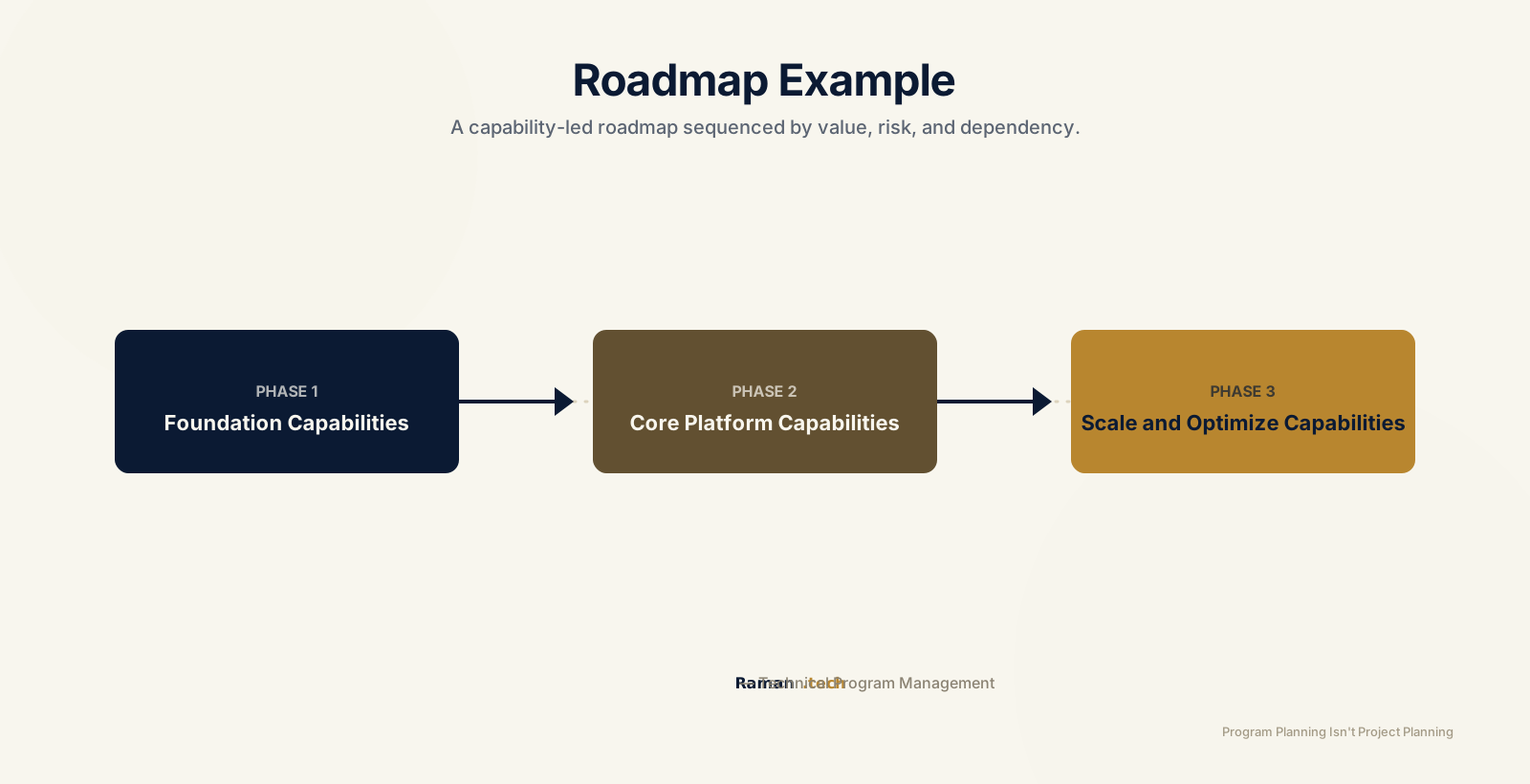
The roadmap below illustrates how capabilities should mature over time.
Below is a practical example of how capabilities differ from features based on enterprise platform engineering programs.
| Capability | Supporting Features |
|---|---|
| Standardize application deployments across engineering | ECD deployment workflows, MasterHelm framework, deployment validation |
| Secure application authentication and secrets management | Vault AppRole integration, secret rotation, runtime authentication |
| Centralize application configuration management | CM integration, configuration versioning, environment promotion |
| Enable organization-wide observability | OpenTelemetry instrumentation, collectors, standardized dashboards |
| Improve production deployment governance | Engineering Pod approvals, release readiness checks, deployment audit trail |
| Reduce deployment variability across teams | Standard deployment templates, reusable pipelines, deployment policies |
A useful validation exercise during planning is to review every feature in the roadmap and ask:
"Which organizational capability does this feature improve?"
If that question cannot be answered, the feature probably does not belong in the program roadmap.
Capabilities provide the structure.
Features provide the implementation.
Confusing the two is one of the quickest ways for an enterprise program to lose focus.
I: Identify Dependencies
If there is one area where Technical Program Managers create the most value, it is dependency management.
Engineering teams are generally very good at managing the work they own.
What consistently delays enterprise programs are the dependencies that exist between teams.
These dependencies rarely appear in sprint boards.
They are discovered during integration, production readiness, security reviews, infrastructure validation, or executive governance—usually much later than anyone would like.
That is why I consider dependency identification one of the first planning activities, not something that happens midway through execution.
"Programs rarely fail because engineers cannot build software. They fail because teams depend on each other more than they realize."
One of the best examples comes from the rollout of the Enterprise Continuous Deployment (ECD) platform.
Although ECD was owned by a relatively small engineering team, its production rollout depended on multiple organizations successfully completing their own deliverables.
The ECD team could build deployment workflows, deployment APIs, and user interfaces.
However, production rollout depended on work owned by Platform Engineering, SRE, Security Platform, DevEx, Infrastructure Engineering, and Product Engineering.
For example, MasterHelm could not be validated until the K8s platform was certified for the target release.
The deployment framework relied on Kubernetes capabilities that became available only after the platform upgrade.
Even though both teams were progressing independently, the overall program could not move forward until that dependency was resolved.
Another example was Vault AppRole adoption.
From an engineering perspective, the implementation was complete relatively early.
From a program perspective, the dependency remained open.
Before organization-wide rollout, the Security Platform team required an extended soak period across integration environments to validate authentication, secret rotation, operational monitoring, and rollback procedures.
The feature was technically complete.
The dependency was not.
That distinction significantly influenced release planning.
We encountered similar situations with Centralized Configuration Management (CM).
Application onboarding depended on standardized configuration management before teams could adopt MasterHelm consistently.
Without CM readiness, deployment automation would have produced inconsistent deployments across environments, defeating one of the primary business objectives of the program.
Observability introduced another important dependency.
During the rollout of OpenTelemetry (OTel), adding instrumentation libraries to applications was only a small portion of the work.
Engineering teams also depended on collector infrastructure, telemetry pipelines, dashboard availability, operational alerting, deployment automation, and platform support.
Treating OTel as a single engineering task would have hidden several cross-functional dependencies that directly affected production readiness.
These examples reinforced an important lesson.
The most important dependencies in enterprise programs are rarely technical.
They are organizational.
A deployment platform depends on infrastructure.
Infrastructure depends on security.
Security depends on governance.
Operations depend on observability.
Product teams depend on platform readiness.
Every dependency becomes part of a much larger delivery chain.
Because of this, I categorize dependencies during planning rather than allowing them to emerge organically throughout execution.
Typical categories include:
- Technical Dependencies — shared services, APIs, deployment frameworks, Helm templates, platform integrations.
- Platform Dependencies — Kubernetes platform upgrades, infrastructure readiness, CM, deployment tooling, observability platforms.
- Security Dependencies — Vault AppRole rollout, security approvals, vulnerability remediation, production security validation.
- Operational Dependencies — SRE readiness, monitoring, production validation, operational runbooks, incident readiness.
- Governance Dependencies — Architecture reviews, Engineering Pod approvals, release sign-offs, production readiness reviews.
- Product Dependencies — Feature readiness, engineering adoption, rollout sequencing, communication plans.
Classifying dependencies this way helps leadership understand where delivery risk exists.
Not every blocker is an engineering problem.
Many require coordination across organizations rather than additional development effort.
One practice that proved particularly effective during the ECD rollout was establishing a centralized Dependency Register.
Every dependency had:
- A named owner
- Supporting organization
- Business impact
- Delivery milestone
- Current health
- Mitigation plan
- Escalation path
Rather than reviewing dozens of Jira boards during governance meetings, leadership reviewed one dependency register that reflected the health of the entire program.
This became the primary planning artifact during weekly release governance meetings.
Instead of asking individual teams whether their sprint work was complete, discussions focused on questions such as:
- Which dependency determines the production Go-Live date?
- What is currently blocking Engineering Pod sign-off?
- Which dependency requires executive escalation?
- What mitigation exists if this dependency slips by one sprint?
Those conversations significantly improved decision quality because they shifted governance away from task completion and toward delivery readiness.
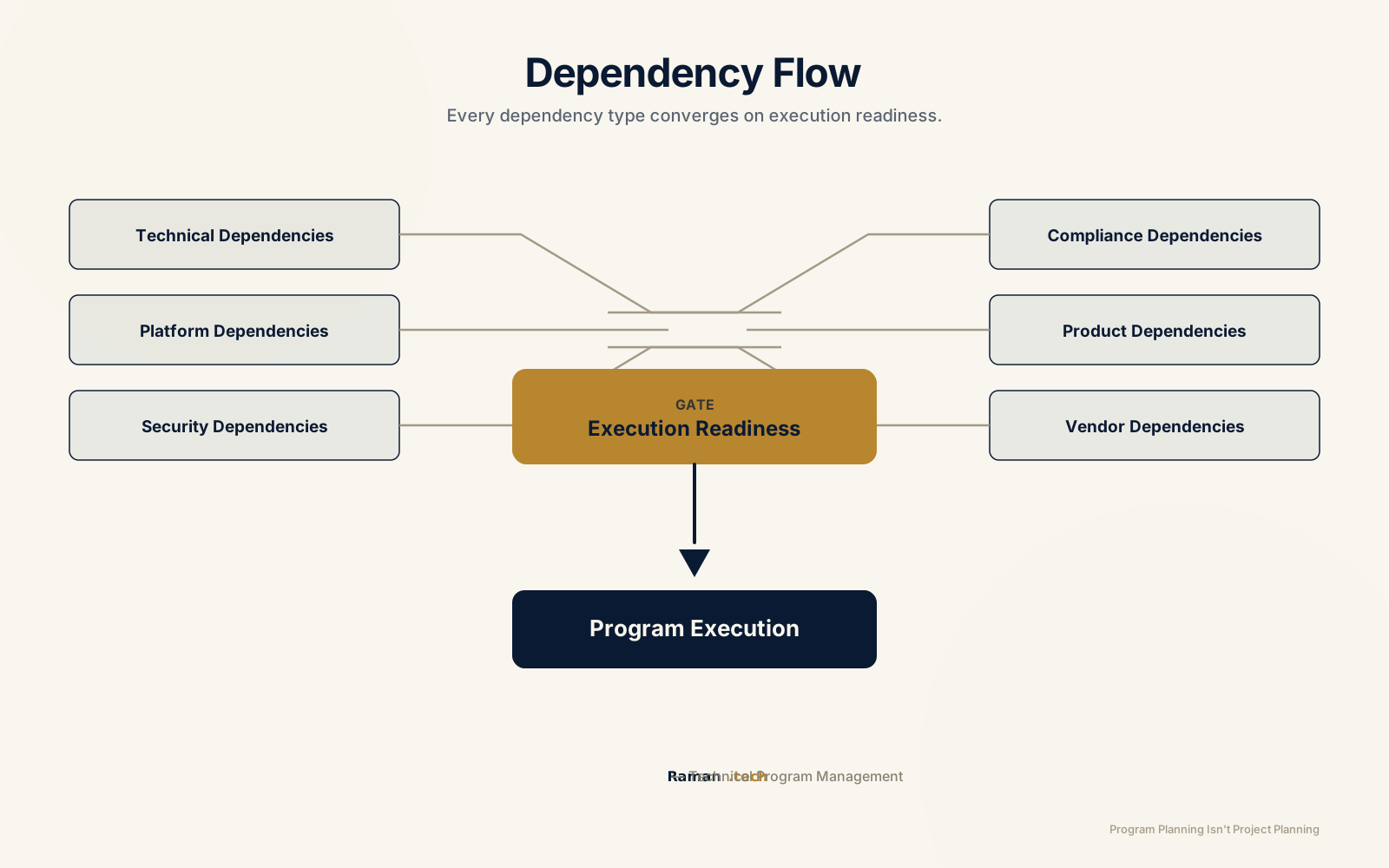
The dependency flow below illustrates how independent workstreams converge before production execution.
One of the most valuable artifacts created during the ECD program was the dependency register shown below.
It became the single source of truth for engineering leadership, release governance, production readiness reviews, and executive status reporting.
Example: ECD Dependency Register
The rollout of Enterprise Continuous Deployment (ECD) involved dozens of cross-functional dependencies spanning Platform Engineering, DevEx, Security Platform, Infrastructure Engineering, SRE, Product Engineering, and Release Management.
A delay in any critical dependency—such as K8s platform certification, Vault AppRole rollout, MasterHelm validation, OCI deployment support, Engineering Pod approvals, or MPOD infrastructure readiness—had the potential to shift the production release timeline.
Rather than tracking these dependencies across Jira Epics, MS Teams conversations, Confluence pages, or weekly meeting notes, we maintained a centralized dependency register that provided a single, program-level view of delivery readiness.
Every dependency was reviewed during weekly governance meetings, with ownership, blocker risk, mitigation plans, and delivery health discussed before production decisions were made.
| Dependency | Owner | Type | Blocker Risk | Target Date | Status |
|---|---|---|---|---|---|
| K8s 12.4.0 platform readiness | Platform Engineering | Platform | High | Sprint 24 | On Track |
| Vault 10.0.0 AppRole rollout | Security Platform | Security | High | Sprint 24 | Tracking |
| MasterHelm chart validation | DevEx Team | Technical | High | Sprint 25 | Tracking |
| OCI deployment support (ECD-319) | ECD Engineering | Feature | High | Sprint 25 | Blocked |
| Cluster View issue (ECD-318) | ECD Engineering | Product | Medium | Sprint 25 | At Risk |
| MPOD production infrastructure | SRE | Infrastructure | High | Sprint 24 | On Track |
| Single Pod sanity validation | SRE | Validation | Medium | Sprint 24 | Tracking |
| Engineering Pod production sign-off | Product Engineering | Governance | High | Sprint 25 | Pending Approval |
| ECD 1.0.0 Production Go-Live | Program Management | Milestone | High | Sprint 26 | Planned |
Key Takeaway: The dependency register was not created for reporting purposes. It was a governance tool that helped leadership make informed release decisions, prioritize executive escalations, and maintain a shared understanding of overall program health. In large enterprise programs, dependency visibility is often a stronger predictor of delivery success than sprint velocity or feature completion.
G: Govern Execution
Even the best program plan will fail without effective governance.
Governance is often misunderstood as status meetings, executive presentations, or approval checkpoints.
In reality, governance exists to accelerate decisions.
When programs become large enough to span multiple engineering organizations, workstreams begin moving at different speeds.
Platform Engineering is waiting for Security.
Security is waiting for Infrastructure.
Infrastructure is waiting for SRE.
Product Engineering is waiting for Platform Engineering.
Without a structured governance model, those dependencies remain invisible until they impact delivery.
"Good governance doesn't create bureaucracy. It creates clarity, accountability, and faster decisions."
One of the most valuable lessons from leading the Enterprise Continuous Deployment (ECD) program was realizing that governance should never revolve around status updates.
Status is an output.
Decision-making is the purpose.
As the ECD rollout expanded across Platform Engineering, DevEx, Security Platform, Infrastructure, SRE, and Product Engineering, it quickly became clear that reviewing Jira Epics or Sprint progress was no longer sufficient.
Every engineering team reported healthy sprint progress.
Yet the production release could still be delayed because one critical dependency remained unresolved.
For example, during one release cycle, engineering development was largely complete.
However, production readiness depended on several independent activities reaching completion:
- Vault AppRole soak validation
- K8s platform certification
- MasterHelm compatibility validation
- MPOD production infrastructure readiness
- Engineering Pod production sign-off
- OCI deployment capability
- Production operational readiness by SRE
None of these appeared as blockers on a single Jira board.
Collectively, they determined whether the release could move to production.
This changed the purpose of our weekly governance meetings.
Instead of reviewing completed stories or sprint velocity, every discussion focused on production readiness.
Typical questions included:
- Which dependency currently determines the Go-Live date?
- Which blocker requires leadership escalation?
- Has every Engineering Pod completed production validation?
- Is SRE operationally ready to support this release?
- Are Security and Platform Engineering comfortable proceeding with production rollout?
- What risk are we accepting if we release this sprint?
Those conversations consistently generated better decisions than reviewing burn-down charts.
Another practice that proved valuable was separating governance forums based on the type of decision being made.
Technical discussions remained with architects and engineering leads.
Program decisions remained with delivery leadership.
Executive trade-offs remained with sponsors.
This prevented meetings from becoming overloaded with topics that belonged elsewhere.
For the ECD program, governance naturally evolved into three operating layers.
The first was the Weekly Program Review.
This became the operational heartbeat of the program.
Program Management, Platform Engineering, DevEx, Security Platform, SRE, Infrastructure Engineering, and Product Engineering reviewed:
- Milestone health
- Cross-team dependencies
- Open blockers
- Production readiness
- Action items
- Escalations
The objective was not reporting.
The objective was ensuring every workstream remained aligned toward the same production milestone.
The second forum consisted of Architecture and Technical Reviews.
These sessions focused on engineering decisions that could affect future delivery.
Examples included:
- MasterHelm architecture decisions
- Vault AppRole integration approach
- CM onboarding strategy
- OpenTelemetry instrumentation standards
- Kubernetes platform compatibility
- Deployment workflow changes
These meetings intentionally avoided program status.
Their purpose was technical quality and long-term platform consistency.
The third governance layer involved Engineering Leadership and Release Governance.
These reviews answered one question:
"Can this release safely move to production?"
Rather than discussing engineering effort, leadership reviewed:
- Critical production blockers
- Dependency health
- Production validation status
- Engineering Pod approvals
- Operational readiness
- Rollback readiness
- Release risks
- Executive decisions required
This became the final production gate before Go-Live.
One practical example illustrates why governance matters.
During ECD production validation, SRE identified two issues that initially appeared relatively small:
- ECD-318 — Cluster View issue
- ECD-319 — OCI deployment support
Neither represented months of engineering work.
However, both affected production operability.
Without resolving those issues, SRE could not confidently support production deployments across all target environments.
Instead of asking Engineering to "finish development," governance discussions shifted toward business decisions:
- Do these issues block production?
- Can rollout proceed with documented limitations?
- Should OCI support move to the next release?
- What operational risk remains after deployment?
Those are program management decisions—not engineering decisions.
That distinction is exactly why governance exists.
A well-governed program makes risks visible before they become production incidents.
It ensures executive decisions are based on delivery readiness rather than engineering optimism.
The governance model below illustrates how decision authority is distributed across the program.
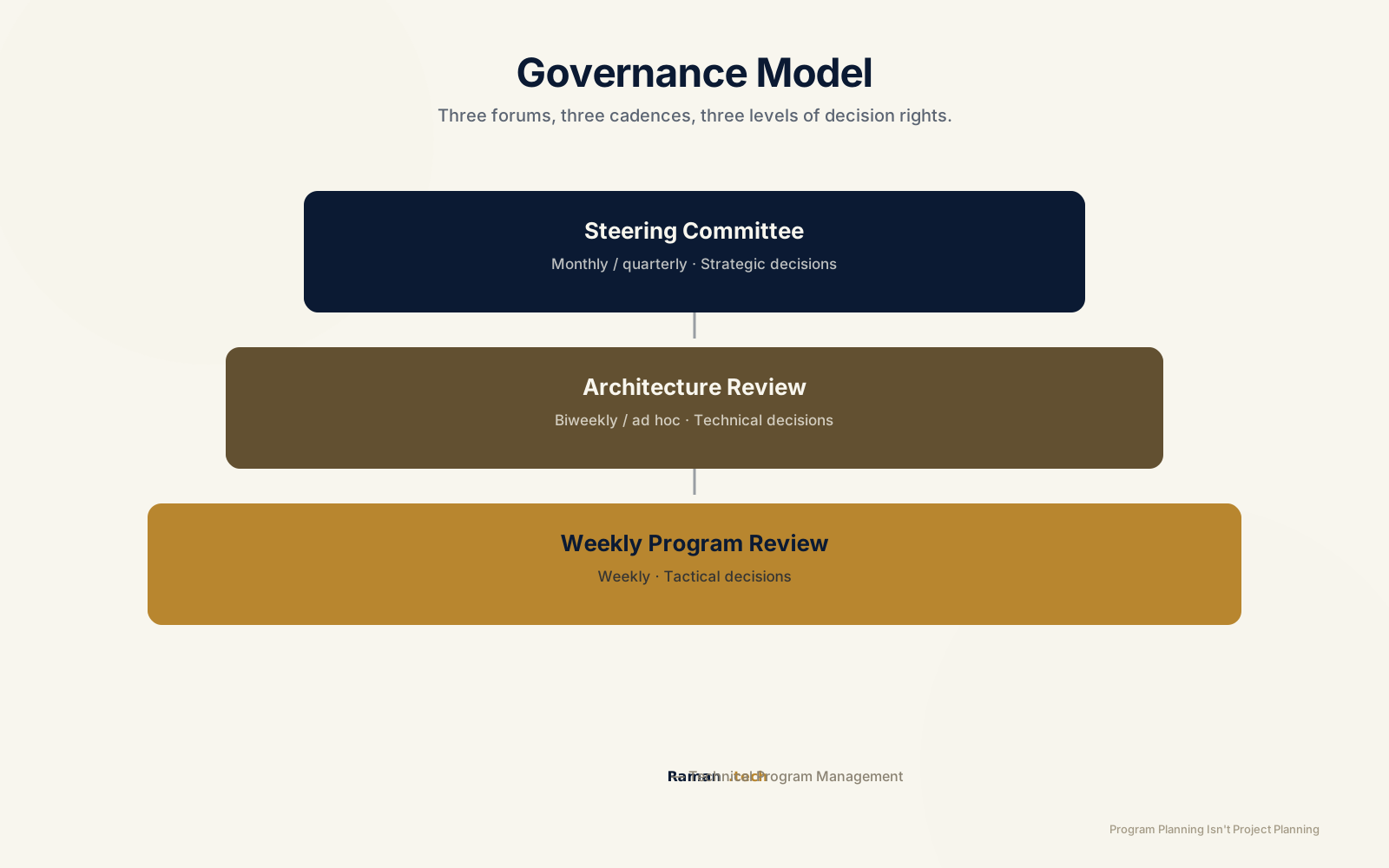
Each governance forum serves a distinct purpose.
| Forum | Primary Purpose | Cadence | Typical Participants | Key Decisions |
|---|---|---|---|---|
| Weekly Program Review | Delivery execution, dependencies, blockers, release readiness | Weekly | TPM, Platform Engineering, DevEx, SRE, Security, Infrastructure, Product Engineering | Resolve delivery blockers, assign actions, escalate risks |
| Architecture Review | Platform architecture, engineering standards, technical direction | Bi-weekly or Ad-hoc | Architects, Principal Engineers, Platform Leads, Security | Technical design approval, platform standards, implementation trade-offs |
| Engineering Leadership / Release Governance | Production readiness and Go-Live approval | Weekly during release | Engineering Directors, TPM, SRE, Platform Leadership, Product Leadership | Production approval, release sequencing, risk acceptance, Go-Live decisions |
| Executive Steering Committee | Strategic direction and investment decisions | Monthly | Executive Sponsor, Engineering Leadership, TPM | Budget, priorities, major scope changes, strategic escalations |
One lesson I have carried into every subsequent program is that governance should never become a reporting exercise.
If a meeting ends without a decision, removing a blocker, assigning ownership, or resolving a risk, governance has failed.
The best governance meetings are not the ones with the most slides.
They are the ones where teams leave with fewer uncertainties than when they entered.
Key Takeaway: Governance is not about monitoring progress—it is about enabling decisions. When structured correctly, governance provides clear ownership, timely escalation, and the decision-making discipline required to keep complex enterprise programs moving toward successful delivery.
N: Navigate Using Metrics
Planning establishes direction.
Governance enables decisions.
Metrics tell you whether the program is actually moving toward its intended outcome.
One mistake I frequently see is organizations measuring only engineering activity.
Sprint velocity increases.
Story points are completed.
Deployments happen more frequently.
Dashboards look healthy.
Yet leadership still asks a simple question:
"Is the program delivering the business value we approved?"
Engineering metrics alone cannot answer that question.
Likewise, business metrics without engineering context make it difficult to understand why progress is slowing.
A Technical Program Manager needs visibility into both.
"Metrics should explain whether the program is healthy—not simply whether teams are busy."
During the Enterprise Continuous Deployment (ECD) rollout, we intentionally avoided measuring success by the number of completed Jira stories or deployment features delivered.
Those metrics were useful for engineering teams, but they did not tell leadership whether the deployment platform was becoming operationally ready.
Instead, we monitored three complementary views of program health.
- Engineering Delivery
- Platform Adoption
- Program Health
Together, they provided a balanced picture of execution.
Engineering Delivery Metrics
Engineering metrics answered a straightforward question:
"Can we build and release software reliably?"
Typical engineering indicators included:
- Deployment success rate
- Deployment failure rate
- Deployment duration
- Rollback frequency
- Mean time to recover (MTTR)
- Production deployment validation success
These metrics helped engineering teams continuously improve delivery quality.
However, they represented only one dimension of program success.
For example, achieving a 99% deployment success rate had little value if engineering organizations were not adopting the platform.
Platform Adoption Metrics
Platform programs succeed only when engineering teams actually use the capabilities that are delivered.
During ECD and MasterHelm adoption, platform health became just as important as engineering delivery.
Examples included:
- Engineering teams onboarded to ECD
- Applications migrated to MasterHelm
- Vault AppRole adoption across supported services
- CM onboarding progress
- OpenTelemetry instrumentation coverage
- Standardized deployment adoption across engineering organizations
These metrics demonstrated whether the platform was becoming part of day-to-day engineering operations rather than remaining another internal tool.
One example was the rollout of Vault AppRole.
Completing engineering implementation did not indicate success.
The real indicator was the number of applications successfully authenticating through Vault in production while eliminating legacy credential management.
Similarly, OpenTelemetry was not considered successful simply because instrumentation libraries had been deployed.
Success required engineering teams to consistently generate telemetry that SRE teams could use for production monitoring, troubleshooting, and operational decision-making.
Program Health Metrics
Program metrics answered an entirely different question:
"Is the overall program still on track?"
These metrics became the primary focus during weekly governance meetings because they highlighted delivery risks before milestone dates began slipping.
For the ECD program, examples included:
- Cross-team dependency aging
- Number of critical production blockers
- Release readiness score
- Engineering Pod sign-off completion
- Infrastructure readiness
- Security approval status
- Production validation progress
- Executive decision backlog
Unlike engineering metrics, these indicators measured delivery confidence.
They helped leadership understand where intervention was required before production rollout.
For example, during one release cycle, engineering delivery metrics remained healthy.
Development milestones were being achieved consistently.
However, program health metrics told a different story.
The dependency register showed several high-risk items still under active tracking:
- Vault AppRole soak validation
- MasterHelm production validation
- OCI deployment capability
- Engineering Pod approvals
Although engineering execution appeared healthy, leadership correctly delayed production until those dependencies reached an acceptable level of readiness.
Without program health metrics, that risk would have remained largely invisible.
Metrics Should Drive Conversations
One principle I have adopted across platform modernization programs is that every metric should support a decision.
If nobody reviews a metric during governance meetings, it probably should not be on the dashboard.
Likewise, dashboards overloaded with dozens of charts often create noise rather than insight.
Leadership rarely needs more information.
They need better information.
For executive reviews, I typically limit dashboards to a small number of high-signal indicators that clearly communicate delivery confidence.
The table below illustrates the categories of metrics that proved most valuable across programs such as ECD, MasterHelm, Vault AppRole, CM, and OpenTelemetry adoption.
| Category | Metric | Sample Indicator | Owner | Frequency | Type |
|---|---|---|---|---|---|
| Engineering Delivery | Deployment Success Rate | ≥ 98% | Platform Engineering | Weekly | Leading |
| Engineering Delivery | Mean Deployment Duration | < 15 minutes | DevEx | Weekly | Leading |
| Engineering Delivery | Rollback Rate | < 1% | SRE | Weekly | Leading |
| Platform Adoption | Applications onboarded to ECD | 80% of target teams | TPM / Platform Engineering | Weekly | Leading |
| Platform Adoption | MasterHelm adoption across engineering teams | 60% of services migrated | DevEx | Weekly | Leading |
| Platform Adoption | Vault AppRole production adoption | 90% of supported services | Security Platform | Weekly | Leading |
| Platform Adoption | CM onboarding progress | 50 applications onboarded | Platform Engineering | Weekly | Leading |
| Platform Adoption | OpenTelemetry instrumentation coverage | 85% of services instrumented | Observability Team | Weekly | Leading |
| Program Health | Open Critical Dependencies | 0 blockers aged > 1 week | TPM | Weekly | Leading |
| Program Health | Engineering Pod Sign-off Completion | 95% of pods approved | Product Engineering | Weekly | Leading |
| Program Health | Production Readiness Score | 90/100 across all dimensions | TPM | Weekly | Leading |
| Program Health | Milestone Variance | < 5% variance from plan | TPM | Weekly | Leading |
One metric that consistently proved valuable during release governance was the Production Readiness Score.
Rather than relying on subjective status such as Green, Amber, or Red, we evaluated readiness across multiple dimensions:
- Platform readiness
- Security readiness
- Infrastructure readiness
- Operational readiness
- Dependency health
- Production validation
- Engineering approvals
This gave leadership a much clearer understanding of whether the program was genuinely ready for production or simply progressing well within individual engineering teams.
The most successful program dashboards I have seen share one characteristic.
They do not attempt to measure everything.
They measure the handful of indicators that help leadership answer three questions:
- Are we delivering reliably?
- Are engineering teams adopting the platform?
- Are we ready to achieve the business outcome?
If the dashboard cannot answer those questions, it is reporting activity rather than program health.
Key Takeaway: Metrics should help leaders make better decisions, not produce larger dashboards. A balanced view across engineering delivery, platform adoption, and overall program health enables TPMs to identify emerging risks early, validate business progress, and guide complex enterprise programs toward successful outcomes.
Enterprise Example
To illustrate how the ALIGN framework comes together in practice, let me share an example from one of the enterprise platform transformation programs I recently led.
The program was the rollout of Enterprise Continuous Deployment (ECD)—an internal deployment platform designed to standardize software deployments across engineering organizations.
At first glance, it looked like a deployment automation initiative.
In reality, it was a large-scale platform modernization program involving Platform Engineering, DevEx, Security Platform, Infrastructure Engineering, SRE, Product Engineering, and Release Management.
Each organization owned a different part of the delivery.
No single team owned the complete outcome.
That is precisely what made it a program rather than a project.
The business objective was never to build another deployment tool.
The organization wanted to establish a standardized deployment platform that would improve deployment consistency, reduce operational overhead, strengthen production governance, simplify onboarding for engineering teams, and create a repeatable deployment process across multiple products.
Everything else—including deployment workflows, UI improvements, APIs, and automation—supported that business objective.
Planning therefore began with organizational capabilities rather than engineering tasks.
Instead of asking, "Which features should be delivered first?", we asked:
- What capabilities must exist before engineering teams can adopt the platform?
- Which dependencies determine production readiness?
- What organizational changes are required before Go-Live?
Those conversations fundamentally changed the roadmap.
Rather than sequencing work by engineering effort alone, the roadmap was organized around platform readiness.
Several foundational capabilities had to be established before production deployment could even be considered.
Examples included:
- MasterHelm standardization
- K8s platform readiness
- Vault AppRole adoption
- Centralized Configuration Management (CM)
- OpenTelemetry (OTel) enablement
- MPOD production infrastructure
- Engineering Pod production validation
Each capability depended on multiple organizations working together.
For example, MasterHelm was not simply a reusable Helm chart.
It became the deployment standard that engineering teams would use across Kubernetes environments.
Before it could be adopted, Platform Engineering needed to certify the K8s platform, application teams had to validate deployment compatibility, DevEx needed to complete deployment automation, and SRE had to verify operational readiness.
Progress by one team alone did not move the program forward.
The capability became available only when every dependency reached an acceptable level of maturity.
A similar situation occurred during the rollout of Vault AppRole.
Engineering implementation completed relatively early in the release cycle.
However, production rollout depended on Security Platform completing extended soak validation across integration environments.
Authentication workflows, secret rotation, operational monitoring, rollback scenarios, and production behavior all required validation before Security approved organization-wide adoption.
From a project perspective, the work appeared complete.
From a program perspective, one critical dependency remained open.
Observability introduced another layer of coordination.
The objective was never to deploy OpenTelemetry libraries into applications.
The objective was to establish a common observability capability across engineering organizations.
That required coordinated delivery across Platform Engineering, application teams, deployment automation, collector infrastructure, dashboards, operational processes, and SRE.
Only after those pieces came together could engineering teams consistently observe application health across environments.
The same principle applied to Centralized Configuration Management (CM).
CM was much more than a configuration repository.
It became a foundational capability supporting standardized deployments, environment consistency, release promotion, application onboarding, and deployment governance.
Without CM readiness, engineering teams could still deploy software.
They simply could not deploy it consistently.
As execution progressed, dependency management became the center of weekly governance.
Rather than reviewing sprint burn-downs or Jira dashboards, leadership reviewed the health of every cross-functional dependency.
Questions during governance meetings typically focused on delivery readiness rather than engineering progress.
Examples included:
- Is K8s certification complete?
- Has Vault AppRole successfully completed soak validation?
- Are Engineering Pods ready to approve production deployment?
- Has MPOD infrastructure completed operational validation?
- Is MasterHelm validated across all target environments?
- Are OpenTelemetry dashboards available for production monitoring?
- Which dependency currently determines the Go-Live date?
Those discussions allowed delivery risks to surface several weeks before they would have affected production.
One example occurred during final production validation.
SRE identified two issues that immediately became program-level risks:
- ECD-318 — Cluster View functionality
- ECD-319 — OCI deployment support
Neither issue represented a major engineering effort.
However, both affected operational readiness.
Without Cluster View, SRE lacked critical deployment visibility.
Without OCI support, deployment standardization could not be extended to all supported environments.
Rather than treating these as engineering defects, leadership evaluated them as delivery decisions.
Should production proceed?
Should OCI support move to the next release?
Could rollout continue with documented limitations?
Those discussions happened because governance focused on business readiness instead of engineering activity.
The most valuable artifact throughout the program was not the Jira board.
It was the centralized Dependency Register.
Every cross-functional dependency had:
- A clearly identified owner
- Delivery milestone
- Current health
- Business impact
- Mitigation strategy
- Escalation path
The dependency register became the single source of truth for weekly governance meetings, engineering leadership reviews, production readiness assessments, and executive status reporting.
Looking back, the engineering implementation was never the most difficult part of the program.
Engineering teams consistently delivered high-quality technical solutions.
The real challenge was coordinating multiple organizations that each owned only part of the outcome.
That experience reinforced one lesson I have carried into every enterprise platform transformation since.
Projects focus on delivering software.
Programs focus on aligning organizations.
When engineering execution, cross-functional dependencies, governance, and business outcomes remain aligned, enterprise programs deliver significantly more than successful releases.
They deliver lasting organizational capabilities.
Common Planning Mistakes
Over the years, I have noticed that enterprise programs rarely fail because engineers cannot build software.
Most delays originate much earlier—during planning.
Looking back at programs such as FrontEnd Modernization, Digital Tranformation Program, Enterprise Continuous Deployment (ECD), MasterHelm, Vault AppRole, and OpenTelemetry, the technical problems were usually solvable.
The planning mistakes were far more expensive.
Here are the patterns I see most often.
Starting with Jira instead of the problem
One of the first questions teams ask is usually:
"Can you create the Epic?"
My response is almost always the same.
"We haven't agreed on the program yet."
Creating Epics, Features, and Stories feels like progress because Jira immediately gives everyone something to work on.
But a well-organized backlog does not mean the program is well planned.
During the early planning of ECD, we deliberately delayed creating detailed execution plans until leadership aligned on the deployment strategy, adoption model, production rollout approach, and success criteria.
Only after those conversations were complete did the Jira structure become meaningful.
Jira is where execution begins.
It should not be where planning begins.
Planning features instead of capabilities
Another mistake I frequently encounter is feature-first thinking.
Engineering teams naturally discuss APIs, UI improvements, deployment workflows, or automation.
Leadership, however, is funding organizational capabilities.
For example, MasterHelm was never funded because leadership wanted another Helm chart.
It was funded because the organization needed standardized deployments across engineering teams.
The deployment templates were simply one implementation of that capability.
Whenever roadmap discussions become feature-heavy, I ask a simple question:
"What organizational capability does this feature enable?"
If nobody can answer, the feature probably belongs in a backlog—not in a program roadmap.
Governance becomes status reporting
Many governance meetings gradually become slide reviews.
Every workstream reports Green.
Every milestone appears healthy.
Everyone agrees to meet again next week.
Nothing actually gets decided.
During the ECD rollout, we intentionally changed the purpose of governance meetings.
Instead of asking teams what they completed, we asked:
- What prevents production this week?
- Which dependency requires executive attention?
- Which decision cannot wait until next week?
That simple shift made governance significantly more valuable.
A governance meeting should remove blockers—not simply communicate them.
Assuming executive alignment
Executive sponsorship is often assumed rather than actively maintained.
Alignment achieved during kickoff does not automatically continue throughout execution.
As enterprise programs evolve, priorities change, risks emerge, and trade-offs become necessary.
One lesson I have learned is to continuously validate executive expectations throughout the program—not just at the beginning.
Regular steering discussions prevented several ECD decisions from becoming engineering debates when they actually required leadership direction.
Discovering dependencies too late
The largest delivery risks I have managed were rarely technical.
They were dependencies that surfaced much later than expected.
For example, production rollout of ECD depended on MasterHelm validation, Vault AppRole readiness, Engineering Pod approvals, K8s certification, MPOD infrastructure readiness, and production validation by SRE.
Every team delivered quality engineering.
The challenge was ensuring every dependency matured at roughly the same pace.
That is why dependency workshops now happen during planning rather than after execution has already started.
Measuring activity instead of outcomes
Engineering organizations naturally measure work completed.
Programs need to measure business progress.
Completing a deployment workflow did not mean ECD was successful.
Success meant engineering organizations were adopting the platform, deployments became more standardized, operational effort decreased, and production governance improved.
Those outcomes mattered far more than the number of completed stories.
"The most successful programs I've managed spent more time discussing decisions, dependencies, and business outcomes than sprint velocity."
Program Planning Checklist
This is the checklist I personally use before committing any enterprise program roadmap.
It has evolved through multiple platform modernization initiatives, including ECD, MasterHelm, Vault AppRole rollout, OpenTelemetry adoption, and centralized platform engineering programs.
If I cannot confidently answer these questions, I know the program is not ready to execute.
| Phase | Questions |
|---|---|
| Before Planning | Do we understand the business problem beyond the requested solution? Is the Executive Sponsor aligned on outcomes and success criteria? Have all engineering organizations and stakeholders been identified? Have we documented assumptions, constraints, and known risks? |
| Planning | Have we defined measurable business outcomes? Are we planning capabilities instead of individual features? Is the roadmap organized around dependency readiness rather than engineering effort? Have Platform Engineering, Security, SRE, Infrastructure, DevEx, and Product teams reviewed the plan? Does every critical dependency have an owner? Is the governance model agreed before execution starts? |
| Execution | Are dependencies reviewed every week? Are decisions documented and followed through? Are blockers escalated quickly rather than waiting for milestone reviews? Are engineering metrics balanced with adoption and program health metrics? Are we prepared to replan if business outcomes become at risk? |
| Governance | Are governance meetings producing decisions? Are executives reviewing business outcomes instead of feature status? Is production readiness evaluated across Engineering, Platform, Security, Infrastructure, and Operations? Are release decisions based on evidence rather than optimism? |
| Closure | Did the program achieve its intended business outcome? What planning assumptions proved incorrect? Which governance practices should become organizational standards? Which artifacts should be reused by future programs? Have we captured lessons before people move to the next initiative? |
Key Takeaways
If there is one lesson I have learned from leading enterprise platform programs, it is this:
A project can succeed while a program fails.
Engineering teams may deliver every planned feature, yet the organization still misses the intended business outcome.
Successful programs require far more than good execution.
They require alignment, capability thinking, dependency management, governance, and meaningful metrics.
The ALIGN framework is simply a structured way to bring those disciplines together.
From my experience leading initiatives such as ECD, MasterHelm, Vault AppRole adoption, CM, and OpenTelemetry rollout, the biggest challenges were rarely technical.
They were organizational.
The role of a Technical Program Manager is not to manage every engineering task.
It is to create the alignment that allows dozens of teams to move toward the same outcome.
That is the difference between delivering software and delivering transformation.
What's Next
The next article in this series, Risk Management Beyond RAID Logs, covers how to build a risk culture, run pre-mortems, and create actionable mitigation plans before execution begins.
Enjoyed this article?
I write about technical program management, engineering transformation, platform engineering, and enterprise delivery. If this article resonated with you, connect with me on LinkedIn or explore more articles in the Insights section.