Executive Summary
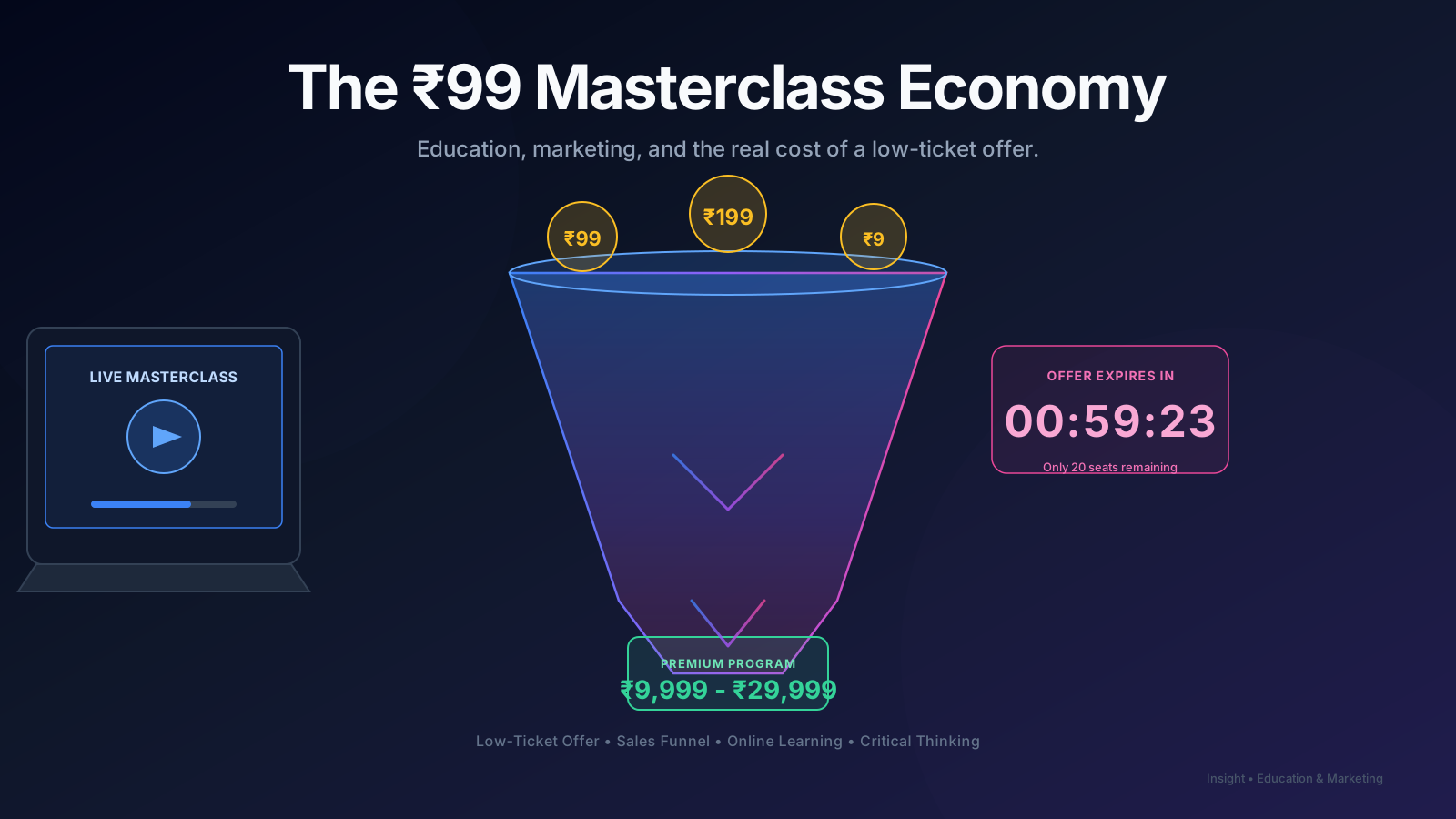
The ₹99 masterclass is often a low-ticket entry point into a larger sales funnel, not the full learning experience. Before buying, check whether the value is in the teaching or in the next course being sold.
Introduction
An observation from a Technical Program Manager who attended enough online masterclasses to notice a pattern.
Over the past few years, India's online learning ecosystem has exploded. Every day, social media platforms are flooded with advertisements for ₹9, ₹99, or ₹199 masterclasses promising career transformation, high-paying jobs, AI expertise, stock market success, freelancing income, and much more.
The pricing is intentionally irresistible. For the cost of a cup of coffee, you get access to a live workshop that promises to change your career.
Like many professionals, I enrolled in several of these sessions—not because I was looking for shortcuts, but because I genuinely enjoy learning and wanted to evaluate the quality of these programs for myself.
After attending enough of them, I started noticing a remarkably consistent pattern.
This article isn't aimed at any individual educator or company. There are many excellent instructors who provide genuine value through affordable courses. Instead, this is an observation about a business model that has become increasingly common in India's online education market.
The ₹99 Isn't Really the Product
One realization changed the way I look at these masterclasses.
The ₹99 session is often not the actual product.
It's the entry point.
In marketing, this is known as a low-ticket offer—an inexpensive product designed to attract potential customers into a larger sales funnel.
Think about it from a business perspective.
Someone who pays ₹99 has already crossed the biggest barrier: they've decided to become a paying customer. That person is naturally more likely to consider a ₹9,999 or ₹29,999 course than someone who never made the first purchase.
There's nothing unethical about this. Businesses have always used introductory offers to acquire customers.
The problem begins when learners mistake the entry point for the complete learning experience.
The Pattern Becomes Predictable
After attending multiple masterclasses from different instructors across different domains, I noticed that many of them followed a surprisingly similar structure.
The session usually begins with inspiring success stories, testimonials, screenshots of student achievements, and the instructor's personal journey. This establishes credibility and builds excitement.
The middle section introduces concepts at a high level. The instructor demonstrates enough knowledge to establish authority and keep the audience engaged, but rarely goes deep enough for participants to build practical competency.
Towards the end, the focus gradually shifts to the premium program. Suddenly the discussion revolves around bonuses, limited-time offers, mentorship, exclusive communities, certifications, placement support, and "today only" pricing.
In some cases, the sales presentation feels longer than the educational content itself.
Again, this isn't necessarily wrong. Selling is part of every business.
But as learners, we should recognize when we're attending a workshop designed primarily to educate versus one designed primarily to generate enrollments.
Information Is Not Transformation
One misconception I see repeatedly is the belief that watching content equals learning.
It doesn't.
Real learning is uncomfortable.
It requires practice, repetition, experimentation, failure, debugging, feedback, and continuous improvement.
A two-hour AI masterclass may introduce prompt engineering, but it won't make someone an AI engineer.
A Kubernetes webinar won't make someone deployment-ready.
A stock market workshop won't turn someone into a successful investor overnight.
At best, these sessions can spark curiosity and provide direction. The real learning begins only after the webinar ends.
Knowledge is introduced during a lecture.
Skills are built through consistent application.
Those two things are often confused.
Marketing Has Become More Sophisticated Than Ever
One thing I genuinely admire about many online educators is their marketing execution.
The landing pages are polished.
The advertisements are compelling.
The storytelling is powerful.
The testimonials build trust.
The follow-up emails and WhatsApp messages are carefully timed.
The sales psychology is remarkably effective.
In fact, some creators have mastered marketing better than the subject they are teaching.
That's not meant as criticism. It's actually impressive.
But it also reminds us that being good at selling education isn't always the same as being good at delivering education.
The Psychology Behind Scarcity
If you've attended enough webinars, you've probably heard statements like:
"Only 20 seats remaining."
"Offer expires tonight."
"This is the last batch at this price."
Sometimes those same offers appear again the following week.
And then again the next month.
Scarcity is one of the oldest principles in marketing because it works. People naturally fear missing out.
The lesson isn't to distrust every offer.
The lesson is to avoid making learning decisions based on countdown timers.
A good course will still be a good course tomorrow morning.
What Changed for Me
These experiences completely changed how I evaluate online courses.
Earlier, I used to ask, "Is this course affordable?"
Now I ask different questions.
Will I actually build something by the end?
Can I see real student projects instead of just testimonials?
How much of the session is dedicated to teaching versus selling?
Would I still buy this course if there were no countdown timer?
Is this solving a real problem in my career, or am I simply experiencing fear of missing out?
Interestingly, these questions have saved me far more money than avoiding expensive courses ever did.
This Isn't an Argument Against Paid Learning
Let me be clear.
I've paid for certifications.
I've purchased books.
I've enrolled in structured training programs.
I've attended workshops that were worth every rupee.
Good educators deserve to be compensated for their expertise.
Affordable education is one of the best things the internet has made possible.
This article is not about pricing.
It's about expectations.
If a masterclass is marketed as an introduction, that's perfectly reasonable.
If it's marketed as a life-changing shortcut, we should pause and think critically.
My Advice to Every Learner
Before enrolling in your next ₹99 masterclass, take a moment to ask yourself a few simple questions.
Real expertise still requires curiosity, practice, discipline, and time.
There are no shortcuts around that.
- Research the instructor beyond social media.
- Look for student outcomes that include real projects, not just testimonials.
- Understand exactly what you'll learn and what you'll build.
- Don't let urgency make the decision for you.
- Most importantly, remember that buying a course is not the same as acquiring a skill.
Final Thoughts
The online education industry has created incredible opportunities for learners and educators alike. It has made knowledge more accessible than ever before, and that's something worth celebrating.
At the same time, it has also made marketing more sophisticated than ever.
As professionals, we evaluate software, architectures, investment decisions, and business proposals with careful analysis. Our learning decisions deserve the same level of scrutiny.
The next time you see an advertisement for a ₹99 masterclass, don't just ask yourself, "Is this worth ₹99?"
Ask a better question:
"What am I really being sold?"
Sometimes the answer is knowledge.
Sometimes it's the first step in a well-designed sales funnel.
Knowing the difference may be one of the most valuable lessons you'll learn.
Key Takeaways
- The ₹99 masterclass is often a low-ticket offer designed to lead buyers into a premium course.
- A two-hour session can introduce ideas, but it cannot replace the practice needed to build real skills.
- Sophisticated marketing, scarcity, and social proof are powerful signals to slow down and evaluate.
- Good courses deliver clear learning outcomes; funnels deliver urgency and upsells.
Enjoyed this article?
I write about engineering leadership, AI, DevOps, developer productivity, career growth, and lessons learned from building enterprise software. If this resonated with you, connect with me on LinkedIn or explore more articles in the Insights section.